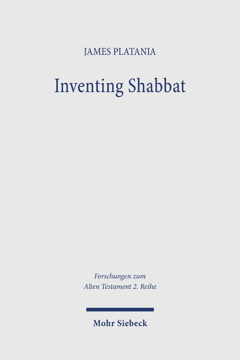
Inventing Shabbat
Moses as Agent of Legal Innovation in the Narrated World of Exodus 15,22–16,36
About the book
When is Shabbat initiated in the biblical story? The familiar answers point to creation, where God rests on the seventh day, or to Sinai, where the commandment is given. Inventing Shabbat identifies Exodus 16 as the narrative context in which Shabbat emerges as an Israelite practice, through Moses’ interpretation of prior divine discourse. In the wilderness of Sin, God promises bread from heaven and instructs the people to gather a daily portion, and a double portion on the sixth day, without any mention of a seventh-day rest. When the people gather the double portion and their leaders report it to Moses, he announces, as the word of God, that the next day is a holy Shabbat, and tells them to keep what remains until morning. The narrative then confirms his interpretation step by step: the kept manna does not spoil, none is found on the seventh day, and God’s own speech affirms that Shabbat has been given. The book reads Exodus 15,22–16,36 as the place where Shabbat first takes shape as a lived practice, discerned and confirmed within narrative time, through Moses’ interpretation of what God has already said and done.
The argument rests on a way of reading. Platania adopts a narrative approach grounded in literary poetics and legal hermeneutics, treating the final form of the text as primary and reading Exodus sequentially from the perspective of a first-time reader, who knows only what the story has so far disclosed. He attends closely to Moses’ speeches and to the way they attribute their content to prior divine utterances, and to the gaps the narrator leaves, which invite the reader to infer a process of interpretation and legal innovation that the text does not spell out. Moses emerges from this reading as a prophetic mediator who interprets earlier divine discourse in response to new circumstances, and whose authority the narrative confirms.
The book’s contribution is to bring narratology and legal hermeneutics into sustained dialogue. Scribal strategies of innovation, familiar from the study of how biblical laws revise one another, are here seen dramatized inside the narrative world, in the speech and conduct of Moses. The result is a model of biblical law as narratively mediated and dynamically unfolding, with implications for the study of Shabbat, legal innovation, prophetic authority, and the composition of the Pentateuch.
Origins
The book is based on the author’s doctoral dissertation at the Pontifical Gregorian University, Rome, directed by Jean-Pierre Sonnet, S.J. and completed for the S.Th.D. in Biblical Theology in October 2024. The dissertation received the Bellarmine Prize for Best Doctoral Dissertation in Theology.
Related lecture
“Moses the Scribe? Techniques of Legal Innovation Reflected in Narrative (Exodus 12–16)”
Cite this book
Platania, James P. Inventing Shabbat: Moses as Agent of Legal Innovation in the Narrated World of Exodus 15,22–16,36. FAT II 182. Tübingen: Mohr Siebeck, 2027.